






















 Contact



Share This Article
In an increasingly competitive digital environment, brands need more than good products to make them stand out. Nowadays, trust and emotional connection with the customer are decisive factors in the purchase process. This is where social selling comes into play, a new strategy that combines the power of social media with selling techniques that are 100% focussed on these new channels and the ways people use and interact with them; what experts call relationship selling techniques.
According to data from LinkedIn, professionals who apply social selling are 51% more likely to achieve their sales targets. Additionally, this study from HubSpot notes that 84% of B2B buyers start their procurement process with a recommendation on social media or an online search.
In this new Blog article from BigBuy, we will help you to understand what social selling is, how to use it in your business, which social media platforms are most effective and which tools can help you to scale your results. All with a practical approach, oriented towards on ecommerce, dropshipping and digital sales. Ready to find out more?
What is social selling?
Social selling is the process of using social media to identify, connect, nurture and convert potential customers by creating valuable relationships and content on these channels.
Unlike traditional selling, which is usually more direct and transactional, social selling is based on accompanying the customer in their decision-making process, providing useful information, answering queries and building trust on social media.
For any seller, this means:
- Having a professional presence on social media.
- Sharing relevant and educational content.
- Interacting authentically with the audience
- Detecting sales opportunities via active listening.
It isn’t about posting products without context, but creating conversations that add value, particularly listening to the trends, habits and behaviours of social media users. It is especially useful for entrepreneurs, ecommerce, dropshipping businesses and B2B sales teams, where trust and reputation are key.
How do you carry out social selling?
Social selling combines three fundamental pillars for sales: strategy, technology and human relationships.
We’ve asked BigBuy’s team of experts and below we break down what they think are the main points to cover when it comes to activating social selling strategies:
Optimised social media presence
A professional presence on social media starts with profiles that are well configured, consistent with the brand identity and visually attractive.
This includes:
- A clear bio
- Suitable profile picture
- Up-to-date links
- And, content aligned with the audience’s interests
Plus, posting constantly and taking care of the aesthetics helps to build trust from the initial contact. An optimised profile doesn’t just improve the perception of your brand, but it also favours its positioning on platforms’ algorithms.
Active listening and valuable content
Active listening consists of observing and analysing your audience’s comments, questions and shares on social media.
This information allows you to create content that truly connects, such as guides, tips, tutorials or success stories. Posting useful and relevant content not only improves engagement, but it also positions your brand as a reliable source and your products as leading ones.
Plus, it enables you to anticipate customers’ needs and offer solutions before they even ask for them.
Constant and personalised interaction
Interacting with your community regularly is key when it comes to building long-lasting relationships. Responding to comments, acknowledging mentions and taking part in conversations shows proximity and commitment.
Personalising messages according to the context and type of customer improves the experience and generates more loyalty. This engagement also feeds the platforms’ algorithms, increasing your organic visibility and the reach of your posts.
Strategic use of networking and recommendations
Digital networking allows you to expand your reach and boost your reputation. Collaborating with influencers, microinfluencers or satisfied customers generates authentic content and recommendations that work as social proof.
These spontaneous mentions or strategic collaborations directly influence the purchasing decisions of other users. In addition, taking part in online communities or events positions you as a leader in your sector and opens up new business opportunities.
What are the advantages of social selling?
The way in which consumers make purchasing decisions has changed radically. Nowadays, 70% of the purchase process is done before contacting a seller.
This means that your social media presence and content may be decisive in capturing and convincing your customers. Furthermore, social media platforms work as generators of need, showing new products or innovations.
Therefore, its benefits go far beyond immediate sales, since it impacts the reputation, loyalty and organic growth of the brand. This is leading an increasing number of brands all over the world to start developing social selling strategies.
Some of the of the main advantages are:
1. The modern customer researches before making a purchase
Users look for reviews, compare prices, evaluate the reputation of brands and consume content before making decisions.
If you aren’t present in this process, you miss out on opportunities.
2. It generates long-term trust
Useful content and interaction help to build a solid relationship with the audience, which translates into increased loyalty and recommendations.
A relationship of trust is a key element in order to speed up the decision funnel; the more confidence you generate as a seller, the quicker the sale will be generated.
3. It improves brand visibility and positioning
A well-executed social selling strategy enables you to stand out from the competition, position yourself as an expert and increase your authority in the sector.
4. It reduces the sales cycle
By nurturing leads with relevant content, the conversion process is sped up, since the customer is more informed and willing.
5. It favours social proof and recommendations
Positive interactions, testimonials and mentions on social media have a direct impact on other users’ decisions to buy, which is key for sales in today’s market.
What are the Advantages of doing social selling with BigBuy?
Now you know that social selling is key to boosting your online sales, you should know that approaching it for the first time can be overwhelming and challenging. BigBuy offers a comprehensive solution for ecommerce and sellers on social media who want to use social selling professionally. Without complications, it’s simple and quick.
Thanks to our experience in dropshipping and multi-channel sales, BigBuy offers you winning products with a high margin, visual materials optimised for social media (banners, images and videos), and a direct connection between your store and its catalogue via a connector.

In addition, using BigBuy as your partner will allow you to:
- Sell without needing to invest in stock.
- Access products with fast delivery from Europe.
- Take advantage of volume discounts.
- Synchronise your ecommerce with its logistics system and catalogue in real time.
All of this turns your social media into a professional and scalable direct selling tool.
👉 Find out more about how BigBuy can boost your social selling strategy here.
What are the disadvantages of social selling?
As with all strategies, social selling also has its challenges. Knowing what they are will enable you to manage them better and prevent frustrations.
- It requires time and consistency: It isn’t a technique that yields immediate results. Building relationships takes time, and requires dedication each day to generate impact.
- Difficulty in measuring immediate results: Unlike advertising campaigns, the results of social selling can take time to be reflected in clear metrics. You need to be patient and measure qualitative indicators.
- Dependence on social media platforms: Changes to algorithms, policies or functionalities can affect the visibility and reach of your actions. That’s why it’s important to diversify and not rely solely on one platform.
Advanced strategies to boost your social selling
Once you have developed your presence on social media, with regular content and an active community, it’s time to apply more advanced strategies that will enable you to scale your results.
Below, we give you five key tactics that you can implement step by step to improve your social selling, whether you are just starting out or already have experience in the field.
Interactive content and multimedia
Visual and interactive content generate higher engagement and help to create an emotional connection with your audience.
Posting explanatory videos, carousels, reels or live streams enables you to show off your product or service in an attractive and dynamic way.
This type of content not only captures people’s attention, but also encourages interaction, which improves your visibility in platforms’ algorithms.
Collaborations with influencers and micro influencers
Working with profiles that are related to your brand enables you to reach new audiences with greater credibility. Micro influencers, in particular, have extremely loyal communities and create authentic content that better connects with the audience.
These collaborations can be organic or sponsored, and are ideal for generating recommendations, reviews and social proof to enhance trust in your brand.
Advanced use of data and analytics
Monitoring your audience’s behaviour enables you to identify what type of content works best, when to post and how to tailor your message.
Analytics tools such as Metricool, Sprout Social or Google Analytics help you to make decisions based on real data. This strategy is key when it comes to optimising ROI, tailoring campaigns and improving the conversion of your actions on social media.
Smart automation
Automation allows you to save time and maintain a constant presence without losing quality.
You can schedule posts, segment audiences and manage automatic responses with tools like Buffer, Later or Zoho Social.
However, it is important to maintain a balance: automate repetitive tasks, but keep human interaction at key moments so you don’t lose authenticity.
Continuous training of the sales team
Social selling doesn’t just rely on content, it also relies on the people who carry it out. Training your team in digital communication techniques, the use of tools and managing online relationships is vital in order to scale results.
A highly trained team can identify opportunities, generate valuable conversations and convert followers into customers more effectively.
Which social media platforms are most effective for social selling?
Although social selling can be used on practically any social media platform, they don’t all offer the same potential, depending on the type of business, audience and objectives. Choosing the most suitable platform depends on the profile of your ideal customer, the tone of your brand, the characteristics of your products/services and they type of content you produce.

Below, we analyse the most effective social media platforms for implementing social selling strategies, with data to back up their impact.
LinkedIn: Ideal for B2B, professional services, software, training 💼
LinkedIn is the most powerful platform for social selling in B2B environments. According to data from LinkedIn, 80% of B2B leads come from this platform, and sellers that use it have 45% more sales opportunities than those who don’t.
Its professional focus, tools like Sales Navigator and the ability to connect directly with decision makers make LinkedIn an essential platform for businesses that sell services, training or software.
Instagram: Perfect for lifestyle, fashion, health, aesthetics 💄
Instagram stands out for its ability to generate visual engagement. This is an ideal channel for fashion, beauty and lifestyle brands to connect emotionally with their customers.
Micro influencers on Instagram reach engagement rates of between 3% and 6%, which is much higher than other platforms.
Additionally, sectors like fashion and beauty have average interaction rates exceeding 9% and 14% respectively according to studies such as those conducted by SocialCat, making it a highly effective environment for visual social selling.
In our blog, you will find a comprehensive guide to show you how to start social selling on Instagram step by step.
TikTok: Useful for young audiences, visual products, informal content 🤳
TikTok has revolutionised digital marketing with its short and viral video format. With more than 1.6 billion monthly active users and an average of 45 minutes of use per day per person, it is a key platform for capturing the attention of young audiences and with a high potential for social selling among these audiences.
It’s ideal for brands that opt for creative, educational or entertaining content.
Facebook: Useful in certain local niches or adult audiences
Facebook continues to be the most used social media platform in the world, with more than 3.06 billion monthly active users.
Although its audience has aged, it continues to be highly effective for local niches, adult audiences and specific communities. 60% of consumers use Facebook to discover products, and 51% use it to make direct purchases.
Plus, Facebook groups enable you to create loyal and segmented communities, ideal for more advanced social selling strategies.
X: For personal brands and fast moving sectors
X is a platform focussed on immediacy and conversation. Although it has lost users in recent years, it is still useful for personal brands, media, technology and sectors with a high rotation of content.
Its short and public format enables you to generate fast interaction, position yourself as a leader and get involved in trends. 50% of shoppers state that X (Twitter) has an influence in their research phase, and it is the fourth most used platform for affiliate marketing and influencer marketing.
Useful tools for the most efficient social selling
The internet has many tools that can help you to activate your social selling strategies. These tools will help you to optimise your strategy, save time and improve your results, facilitating active listening, posting or automation.
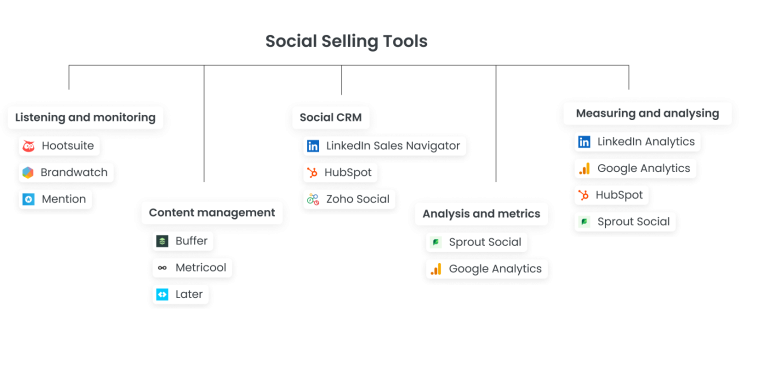
Tools for listening and monitoring:
- Hootsuite: tracking mentions and keywords.
- Brandwatch: analysis of sentiment and reputation
- Mention: real-time alerts about your brand.
Tools for managing content:
- Buffer: scheduling of posts.
- Metricool: content analysis and planning.
- Later: ideal for Instagram and TikTok.
Social CRM tools:
- HubSpot: management of leads and automation.
- Zoho Social: CRM integrated with social media.
- LinkedIn Sales Navigator: advanced search of prospects.
Tools for analytics and obtaining metrics:
- Sprout Social: detailed engagement reports.
- Google Analytics: tracking traffic from social media platforms.
Tools to measure and analyse:
To obtain precise data and make informed decisions, use tools such as:
- LinkedIn Analytics: measures SSI and the performance of posts.
- Google Analytics: analyses traffic and conversions from social media.
- HubSpot: tracking of leads and sales attribution.
- Sprout Social: detailed engagement and growth reports.
How do you measure the success of your social selling?
Measuring the impact of social selling can be complicated because it doesn’t always translate into immediate results. However, there are some key metrics that allow you to evaluate whether your strategy is working and how to optimise it.
Below, we explain the most important ones and how to interpret them.
Engagement metrics
Engagement reflects the level of interaction generated by your content. It includes likes, comments, shares, clicks and viewing time. A high engagement rate indicates that your content is relevant and connects with your audience.
💡 How to interpret it: If your posts have lots of views but little engagement, you need to adjust the content to make it more attractive or better segment your audience.
⚙️ Recommended tools: LinkedIn Analytics, Instagram Insights, Metricool.
Generation and quality of leads
Attracting followers isn’t enough; the goal is to turn them into qualified contacts. This type of metric measures the number of leads obtained, their level of interest and conversion rate.
💡 How to interpret it: If you generate lots of leads but few of them become customers, check the quality of your content and segmentation.
⚙️ Recommended tools: HubSpot, Zoho CRM, LinkedIn Sales Navigator.
Conversions and sales attributed to social media
Analyse the direct or indirect sales that come from social media. This includes purchases made after interacting with your content or clicks on shared links.
💡 How to interpret it: If traffic from social media is high but sales are low, check the user experience on your website and the clarity of your calls to action.
⚙️ Recommended tools: Google Analytics, Shopify Analytics, Sprout Social.
Growth of the network and relationships built
Evaluate the number of followers, connections and conversations started. Constant growth indicates that your strategy is generating visibility and authority.
💡 How to interpret it: If your network is growing but there isn’t any interaction, you need to work on more relevant content and on personalising messages.
⚙️ Recommended tools: LinkedIn SSI (Social Selling Index), Hootsuite.
Common errors when social selling (and how to avoid them)
Although social selling is a powerful strategy, many businesses make mistakes that make it less effective. Identifying them and correcting them is key to obtaining sustainable results.
- Using a personal profile as a product catalogue: Turning your profile into a shop window full of advertising posts leads to rejection and reduces credibility. Social selling is based on adding value, not selling aggressively.
How to avoid it: Alternate educational content, tips and trends with commercial posts. Think of your profile as a space to build trust, not just for making sales.
- Not tailoring the message to each social media platform: Each platform has its own language and format. Posting the same content on LinkedIn and TikTok without making any adjustments may look unprofessional or out of place.
How to avoid it: Adjust the tone, design and type of content according to the platform. For example, use a more professional approach on LinkedIn, opt for a visual approach on Instagram and be creative on TikTok.
- Being invasive in direct messages: Sending mass messages or messages that are overly commercial without context generates rejection and can harm your reputation.
How to avoid it: Personalise each message, research the prospect and offer value before talking about your product. A genuine conversation always works better than an aggressive pitch.
- Only talking about the brand and not listening to the audience: Posting content focussed solely on your company without responding to comments or questions conveys a lack of interest.
How to avoid it: Practice active listening. Answer queries, acknowledge mentions and take part in conversations. Social selling is a two-way process: it’s about connecting, not just communicating.
- Posting content without a strategy or consistency: A lack of planning leads to inconsistent posts and messages that aren’t aligned with objectives.
How to avoid it: Set up a posting schedule, set clear objectives and measure results. Consistency and coherency are essential when building trust and authority.
Frequently asked questions about social selling
Is social selling only for B2B?
No. Although it is highly effective in B2B, it also works in ecommerce, consumer products and services.
How long does it take to see results?
It depends on the sector and the consistency. Normally, the first results can be seen in between 3 and 6 months.
How can social selling help in dropshipping businesses?
It enables you to generate trust in products that are not handled directly, improve brand perception and increase conversions.
Is it possible to automate social selling?
Yes, but in moderation. Automation helps you to scale, but human interaction is still key when it comes to building authentic relationships.
Social selling isn’t just a trend, it’s a natural progression of the way in which brands connect with their customers in the digital environment. Using it correctly can make the difference between a passive online presence and an active strategy that generates sales.
With the right tools, good planning and support from experts like BigBuy’s team, any business can transform its social media into a powerful and sustainable sales channel.