






















 Contact


Share This Article
A product bundle is an ecommerce sales strategy that consists of grouping several items into a single package with a clear value proposition, usually at a more attractive price than if bought separately. This approach helps increase the average order value, enhances the customer’s perception of savings, simplifies their purchase decision, and optimizes catalog turnover.
Why Have Bundles Become Key in Ecommerce?
Because they allow you to increase the average order value without needing more traffic. Bundles encourage customers to buy more in a single transaction, improve value perception, and help differentiate your store in a highly competitive environment where every visit counts. By grouping relevant products, you multiply revenue and optimize each session.
A bundle:
- Increases the average cart value by encouraging the customer to add more units or complementary products.
- Improves customer experience, as they feel they get more value and avoid having to search for each item individually.
- Helps optimize costs and operations by concentrating sales into fewer orders and simplifying logistics management.
Additionally, bundles make it easier to work on brand positioning, create differentiated offers compared to competitors, and adapt quickly to trends or seasonal campaigns (Black Friday, Christmas, back-to-school, etc.).
At BigBuy, we work with a specialized B2B dropshipping model that allows retailers to sell without holding stock. If you want to dive deeper into how this model works, you can explore more details about our dropshipping solution.
Why Do Bundles Help Boost Ecommerce Sales?
Bundles work because they influence several online buyer decision triggers simultaneously. They don’t only affect price but also how the user perceives the value of the offer.
1. They Naturally Increase Average Order Value
When you present a well-constructed pack, the customer finds it logical to take “the complete set” instead of a single product. They don’t feel like they are “spending more,” but rather “making the most of the purchase.”
Example: A coffee machine + capsules + free mugs. The pack has a higher total price, but also higher perceived value.
2. They Strengthen the Perception of Savings
Even if the discount is not aggressive, simply seeing a breakdown (“Previously €79, now €59 in a bundle”) reinforces the sense of opportunity. The customer feels they are buying smart.
3. They Reduce Decision Fatigue
Large catalogs require comparing products, formats, and prices—an exhausting process. A bundle simplifies the process: “take this, it’s already put together for you.” This reduction in friction improves conversion rates, especially among undecided users or those with little time.
4. They Are Especially Effective for Ecommerce Stores With Large Catalogs
The larger your catalog, the more sense bundles make. You can use them to:
- Group complementary products
- Move strategic inventory
- Test new categories
This is why bundles are particularly powerful for wholesale models, B2B ecommerce, and dropshipping, where the catalog is broad and dynamic. The key to scalable bundles is access to an extensive, updated assortment. BigBuy offers a full catalog with thousands of items, making it easy to build high-demand complementary packs.
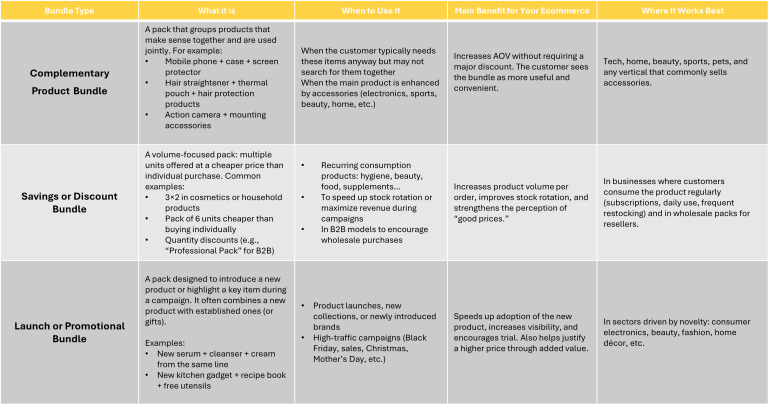
Most Common Types of Product Bundles
Not all bundles work the same or pursue the same goal. Choosing the right type based on your business and customer is essential for real impact.


How to Create an Effective Product Bundle
Simply grouping products and lowering the price is not enough. A successful bundle requires strategy and understanding customer behavior.
1. Coherence: Products Must Make Sense Together
If the customer doesn’t clearly understand why the products are grouped, they will see the bundle as forced.
Ask yourself: Would I buy this set if I saw it in a physical store?
2. Clear, Easy-to-Understand Value
The user should instantly understand:
- What the bundle includes
- How much they save or what extra value they get
- Who it is for or what situation it solves
Tip: Use clear bullets and summaries like “Ideal for…” on product pages.
3. Simplicity
The more variables (sizes, colors, combinations), the harder the decision. Better to offer a few well-defined bundles than many barely differentiated ones.
4. Common Mistakes to Avoid
- Forced bundles grouping unrelated items just to clear stock
- Unclear or inflated discounts
- Too many bundle variations, causing choice paralysis
- Not updating bundles based on performance or seasonality
5. Test, Measure, Adjust
Bundles are ideal for data-driven optimisation:
- Create 2–3 variants and compare performance
- Track conversion rate, AOV, margin, returns
- Adjust composition, pricing, and messaging
Professional teams iterate continuously—this is what separates an average bundle from one that drives meaningful business results.
Bundles and Dropshipping: A Strategic Combination
Dropshipping adds an interesting layer to bundles: you can create and test packs without investing in stock or assuming logistical risks.
Increase AOV Without Increasing Risk
Traditional models require buying more stock and storing more SKUs. In dropshipping, you group products from the supplier’s catalog, test them in your store, and keep only the winners.
Business benefits:
- Higher revenue per order without increasing CAC
- Higher margin via bundle pricing
- Fast scalability for top-performing bundles
Simplifies Customer Decisions in Large Catalogs
Dropshipping catalogs often contain thousands of SKUs—this is both an advantage and a potential source of overload.
Bundles transform abundance into clarity:
- Packs tailored to customer types (entrepreneur, family, athlete…)
- Bundles solving specific situations: “home office kit,” “travel kit,” “new home kit”
Allows Differentiation Even If Competitors Sell the Same Products
One of dropshipping’s main challenges is product overlap among stores. Bundles offer direct differentiation without changing suppliers:
- Unique combinations competitors don’t offer
- Added-value positioning (themed packs, professional packs, starter kits…)
- A unique offer even if the underlying products are identical
BigBuy also offers ready-made wholesale packs designed for resellers wanting to buy volume with optimized selection.
Conclusion: When and Why to Bet on Product Bundles
Product bundles are one of the most powerful and versatile tools to grow an ecommerce business profitably. They are not just “cheap packs” but a way to:
- Increase AOV without raising CAC
- Improve customer experience
- Optimize catalogs and stock
- Differentiate in competitive environments like dropshipping
Bundling makes sense when:
- Your catalog includes complementary or recurring consumption items
- You want to boost launches or campaigns
- You work with wholesale or dropshipping and need to increase order value
FAQ: Frequently Asked Questions About Product Bundles
1. What Exactly Is a Bundle in Ecommerce?
A bundle is a package of multiple products sold together as a single offer, usually with a better value proposition than buying them separately (price, convenience, or both).
2. Do Bundles Always Need a Discount?
No. Many bundles are based on convenience (everything you need in one pack) or added value (accessories, gifts, extended warranties). A discount helps but is not required.
3. How Many Products Should an Ideal Bundle Include?
It depends, but most effective bundles include 2–5 items. More than that can complicate decision-making and dilute perceived value.
4. Can Bundles Improve My Store’s SEO?
Yes. Each bundle can have its own optimized product page targeting specific search intent (“kit,” “pack,” “bundle”), helping capture high-intent traffic.
5. Do Bundles Make Sense in Dropshipping?
Absolutely. Bundles help increase AOV, differentiate your store even if others sell similar products, and test combinations without stock risk.