






















 Contact


Share This Article
How do I start selling third-party products on Amazon and make it a success?
In recent years, selling third-party products on Amazon has become one of the most popular ways to start an e-commerce business.
Amazon has become one of the world’s most powerful marketplaces, with an increasing number of entrepreneurs choosing to sell third-party products on this platform. Due to its low initial costs and the tools the marketplace provides, more and more entrepreneurs are giving this business model a try.
According to a Statista study on Amazon´s growth, the platform dominates over 37% of the US e-commerce market, and continues to grow in Europe, positioning itself as the first choice for millions of consumers. But can you sell products from other brands on Amazon without manufacturing or registering them as your own? Yes, as long as certain conditions are met, sellers can resell third-party products, including those from well-known brands.
Read our guide on dropshipping on Amazon to learn more about this model, which eliminates the need to hold stock.
👉 At BigBuy, we help thousands of businesses and entrepreneurs like you sell on Amazon through automated dropshipping. This means you don’t need to hold stock, and your catalogue and orders are fully synchronised.
Why sell third-party products on Amazon?
This model is particularly attractive for those who are just starting out or who are seeking a low-risk solution. Read on to find out why.
- Low initial investment and simplicity of setup. You don’t need to create your own product or brand, nor do you need to have initial stock available. You can start with a small amount of capital and grow your business over time. Read our post for an idea of initial costs: How much does it cost to sell on Amazon?.
- Immediate access to a huge audience. Amazon receives millions of visits every day. By publishing a product on its marketplace, you automatically gain access to a global client base that already trusts and uses the platform. You won’t need to generate traffic from scratch.
- You don’t need to develop your own brand. You can sell well-known third-party products on the marketplace, which minimises the amount of work you need to do on branding, design and marketing.
- Ideal for testing niches. This model allows you to experiment with new product categories and niches without making large investments. If a product sells well, you could consider developing your own brand in the future.
- Simplified and scalable logistics with Amazon FBA. With the Fulfillment by Amazon (FBA) programme, you can outsource stock management, shipping and customer service, freeing up time and resources. Here’s a comparison between FBA and dropshipping.
What steps do I need to take to start selling third-party products?
Although selling third-party products on Amazon may seem complicated at first, if you follow a clear roadmap and use the right tools, the process becomes much easier. Here, we provide a step-by-step guide to launching your activity as a third-party product seller on Amazon and explain how to get it right from day one.
You will need to make some key decisions along the way, such as what type of account to create, how to choose suitable products, which logistics strategy to adopt, and how to avoid mistakes that could affect your reputation. Let’s get started!
Creating a seller account on Amazon
The first step is to open an account on the Amazon Seller Centre. This is the platform through which you will manage all aspects of your selling activity.
Amazon offers two types of account:
- Individual account: With no monthly tariff, created for those planning to sell less than 40 products per month. This account is useful for initial trials but has limited functions.
- Professional account: With a fixed monthly tariff of around €39 in Europe, it allows unlimited selling and provides access to advanced tools such as sales reports, promotions and API connection, as well as optimising catalogue management. If you’re serious about your business, this is the model for you right from the start.
💡 BigBuy tip: Make sure you have your tax information (NIF/VAT number), a valid bank account and identification documents ready before registering. Amazon has a strict verification process. Antes de darte de alta, asegúrate de tener preparados tus datos fiscales (NIF/CIF), una cuenta bancaria válida y documentación identificativa. Amazon tiene un sistema de verificación riguroso.
Choose profitable and legal products
One of the keys to success is choosing carefully which products to sell. Although it may be tempting to upload any item, you should actually be strategic about it.
Here are some basic criteria:
- High demand and low competition: Use tools like Helium 10, Jungle Scout and Google Trends to detect real browsing trends on Amazon. It’s not enough for something to sound good, there needs to be data to back it up.
- Attractive profit margin: Aim for products with a gross margin of at least 30%. Bear in mind that Amazon charges a commission on each sale, so select items that are priced high enough to cover these costs without reducing your profitability.
- Avoid prohibited, restricted or poor-quality products. Some items, such as food, cosmetics, healthcare products and electronics requiring technical certificates, require permits or are prohibited unless certain requirements are met. Always read Amazon’s restricted products policy before adding items to the catalogue.
- Legal compliance and EU regulations: If you are planning to import products from outside the EU (for example, from China), ensure they have the necessary certifications, such as the CE mark and RoHS compliance. Selling non-compliant products may result in returns, penalties, or even account closure. Ideally, you should work with a trusted supplier such as BigBuy to build a catalogue of certified, quality products.
💡 BigBuy tip: We pre-select products on our platform that are ready to sell on Amazon. These products are optimised and comply with European regulations, saving you all the preparatory work.
Correctly publishing products on the Amazon catalogue
Once you have decided which products to sell, the next step is to publish them correctly. There is a significant difference between creating a product from scratch and ‘uploading’ one that already exists in the Amazon catalogue.
- Adding an existing product: Search for the product using its ASIN code (Amazon identification code) to become a seller. This prevents catalogue duplication and enables you to compete with other sellers of the same product via the Buy Box.
- Optimise the content whenever possible. Although the listing already exists, there are aspects you can work on to improve visibility and conversions, such as:
- A clear product description emphasising its benefits.
- Bullet points with key features.
- Attractive and professional images.
- Well-integrated keywords.
- A dynamic pricing strategy.
- Stock control and synchronisation: If you work with dropshipping or have an extensive catalogue, it is essential that your stock levels are always up to date. At BigBuy, we offer automatic integration to keep your listings synchronised and prevent you from selling out-of-stock products. This is the best way to maintain an up-to-date catalogue without any hassle.
Logistics options: FBA vs. FBM
One of the major decisions is whether you will manage stock and shipping orders yourself (FBM – Fulfillment by Merchant) or delegate this to Amazon (FBA – Fulfillment by Amazon).
Let’s take a look at the main differences:
| Model | What Involves? | Advantages | Disadvantages |
| FBA | Amazon stores, prepares and ships the product, as well as handling returns and customer services. | Greater visibility, access to Prime, less operational workload. | Higher fees, less control over logistics, possible storage charges. |
| FBM | You (or your supplier) handle shipping and customer services. | Greater control, lower logistics fees. | More work, less visibility, not eligible for Prime. |
💡 BigBuy tip: Use an intermediary platform like BigBuy to combine both models and automate dropshipping, synchronising with Amazon to minimise logistical errors.

Can I sell branded products on Amazon without infringing rights?
One of the most common questions about selling third-party products on Amazon is whether it is legal to resell products from well-known brands without being the manufacturer or official distributor. The short answer is yes, but there are conditions.
Amazon allows the reselling of authentic third-party products, provided certain principles relating to intellectual property and product presentation are complied with. Let’s look at the circumstances in which this can be done legally and without risk:
Sell original, new and unmodified products
You can resell branded products legally acquired and not altered. This principle is known as the ‘exhaustion of rights doctrine‘, which means that, once a product has been sold for the first time by the manufacturer or authorised distributor, the rights holder cannot prevent its resale.
👉 Real-life example: You can buy Sony headphones from an official supplier, such as Amazon. However, you cannot sell modified versions or those without the original packaging.
If you use the brand name in a generic or informational context
Some words are registered trademarks but are also used as common names. You can mention these as long as you do not cause any confusion or imply that the product is endorsed or manufactured by that brand.
👉 Correct example: ‘Mount compatible with GoPro’
❌ Incorrect: ‘Original GoPro mount’ (if it is not)
Indicate compatibility without causing confusion
Amazon allows you to state that a product is compatible with another, provided this information is clear and objective, and does not mislead the buyer. This is common in categories such as mobile phone accessories, electronics, and replacement parts.
💡 Use phrases like:
- ‘Compatible with…’
- ‘Designed for…’
- ‘Suitable for models of the brand…’
How to avoid legal problems with registered brands on Amazon
If you don’t take certain precautions, Amazon may block your products or even your account for infringing its rules on intellectual property. Here is some good practice to avoid this happening to you:
- Only sell authentic products in good condition. Avoid reconditioned or unpackaged products if they are not clearly labelled as such.
- Check the source of your products. Working with a trusted and fully reliable supplier like BigBuy will ensure safe, smooth and legal sales.
👉 At BigBuy, we ensure that our products comply with European regulations and those of Amazon, thereby minimising the risk of fines or complaints.
Mistakes to avoid when selling third-party products
Although selling on Amazon can be a great opportunity, it can also be a very demanding environment. Here are the most common mistakes that sellers make when starting out with this model:
- Failure to check the legality and authenticity of products. Selling counterfeit, used or reconditioned products as new can result in your account being suspended with immediate effect.
- Working with unreliable suppliers. Without traceability or valid invoices, you will not be able to prove the legitimacy of your products to Amazon.
- Copying listings without customising them. Even when selling an existing product, adapt the description, bullet points and images so that you stand out from other sellers.
- Ignoring actual fees. Amazon charges referral, storage, shipping (if you use FBA) and return fees. Not keeping these in mind may wipe out your profit margin.
- Underestimating the importance of stock and logistics. Selling products that are not actually in stock or that have a long delivery time may lead to a poor customer experience and affect your reputation.
- Failing to provide adequate customer service. Amazon puts a high value on service quality: fast responses, problem resolution, smooth returns.
BigBuy: the most reliable supplier for selling on Amazon
Having a reliable and scalable product and a logistics supplier who meets Amazon’s requirements is one of the key factors for your success. This will help you avoid the main risks associated with selling third-party products on Amazon:
- Lengthy delivery times. This may happen if you use suppliers with distant warehouses or who ship from China. At BigBuy, however, our warehouses are distributed throughout Europe, enabling us to offer Prime services and fast shipping options for quick worldwide delivery.
- Lack of documentation. If Amazon asks you to prove a product’s origin and you are unable to do so, you may lose the Buy Box or even have your listing removed. With BigBuy, however, you won’t have these issues as all the necessary documentation is ready for use on the marketplace and for resolving any disputes or claims.
- Customs issues. If you import from outside the EU, you need to consider the higher costs and possible penalties. These problems can be avoided by centralising all your operations and business within Europe with BigBuy.
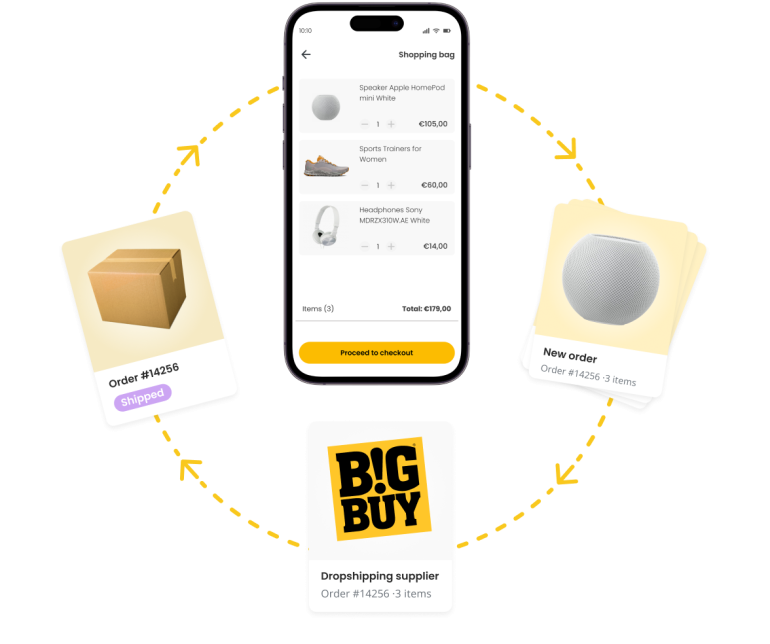
💡 With BigBuy, you can avoid many of these risks, as we work with physical stock in Europe and offer automatic Amazon integration and prior quality control. BigBuy is Europe’s leading wholesale supplier specialising in dropshipping and Amazon synchronisation.